
Industry: Mining | Service: Material Handling
Coal production was going strong in the 1990s and reached its highest level of production in 2008 before it declined in 2015, according to Congressional Research Service. However, Sandwich Belt high angle conveyors were already laying the groundwork for efficient and economical materials handling as early as May 1984. Since then, Sandwich Belt conveyors continued to find a place in coal-handling projects around the world for decades following the very first installation.
FIRST COMMERCIAL UNIT CREATING A DIRECT ROUTE
In 1983, the coal handling facilities at the Buckskin Mine in Gillette, WY USA did not provide a direct route for transporting pit blend coal to the train load-out silos. The system consisted of a series of conveyors that routed all mined coal, after primary crushing under the truck dump, through a secondary crusher, a two-stage sampling system at transfer tower 1, one of six storage silos, through a three-stage sampling system at transfer tower 2, and onto the train load-out silos. The six storage silos provide a means for blending the coal exactly to customer specifications.
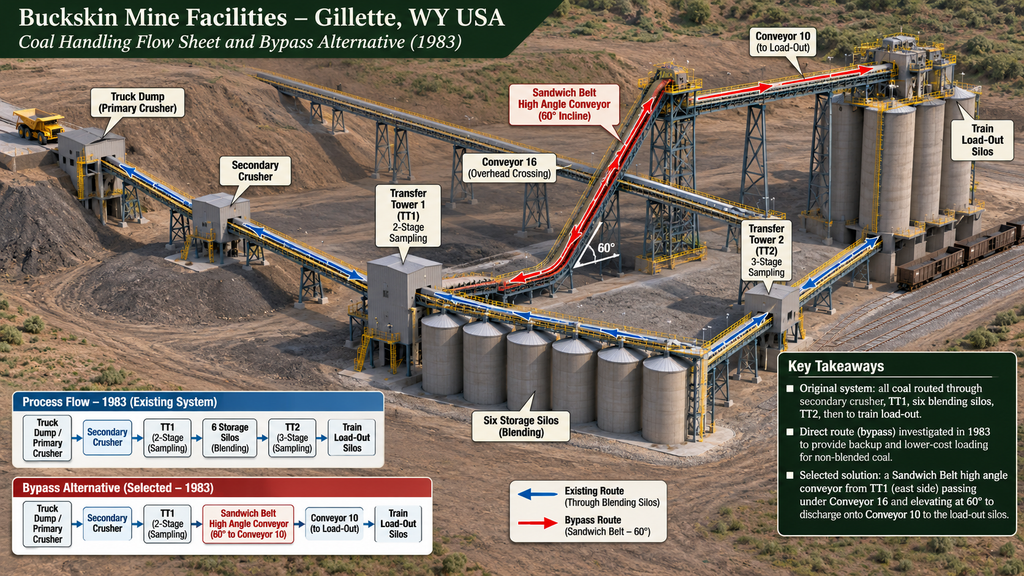
In mid-1983 an investigation began into various alternatives for conveying coal directly to the load-out silos, thus bypassing the blending silos. A direct route offered the advantages of a backup to the existing system and the potential for savings associated with direct loading of coal that does not require blending to meet the less stringent specifications of some customers.
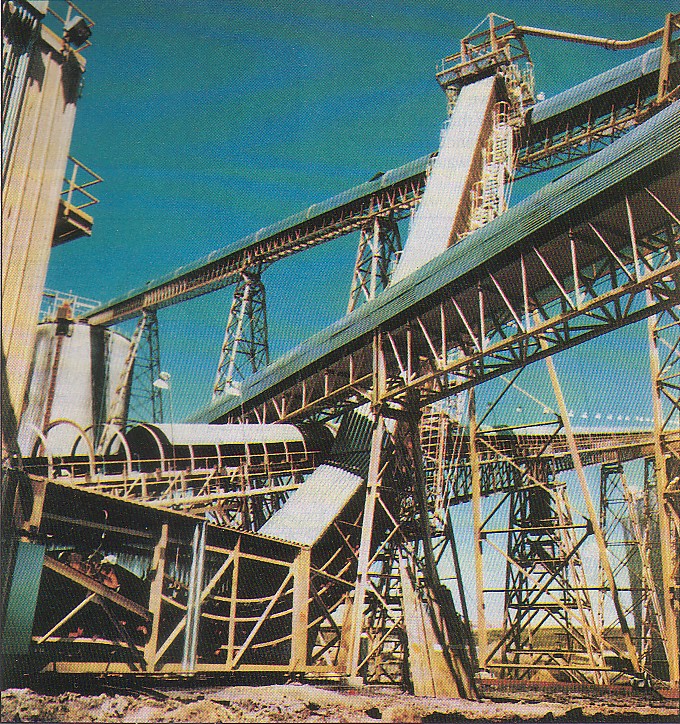
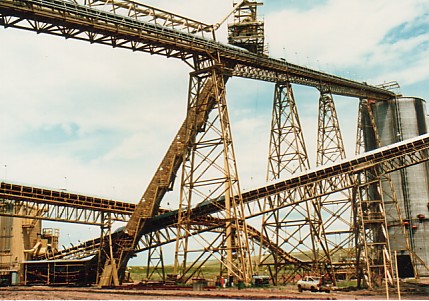
Several different alternatives to bypass the storage silos were investigated. These ranged from a conventional conveyor spanning between the top of the first storage silo and the load-out silos to several steep-angle conveying alternatives. The various steep angle conveying alternatives were based on receiving material from conveyor 2 at transfer tower 1. One alternative considered a conventional conveyor exiting the south side and the east side of transfer tower 1 and running along the ground towards the load-out silos, and a steep angle conveyor elevating the coal to the top of the load-out silos. Other steep angle conveying alternatives considered exiting the south side and the east side of transfer tower 1 and elevating the coal to discharge onto conveyor 10. The alternative chosen utilized a steep angle conveyor exiting the east side of transfer tower 1 and elevating onto conveyor 10 which takes the coal to load out. The steep angle conveyor must pass underneath conveyor 16 before rising to discharge onto conveyor 10, requiring a steep conveying angle of 60 degrees.
Various steep angle conveying systems were considered and the Sandwich Belt high angle conveyor was ultimately chosen.
HAULAGE FROM UNDERGROUND
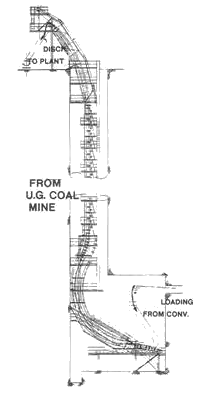 The function of elevating coal from underground along a vertical shaft was realized in Elkhart, IL USA. This Sandwich Belt system fulfilled the greatest potential, realizing the greatest savings in the entire mine through prep plant sequence. The 1524 mm wide high angle conveyor elevated the entire coal mine production at 1364 t/h, 104m vertically to the surface discharging onto the plant fee
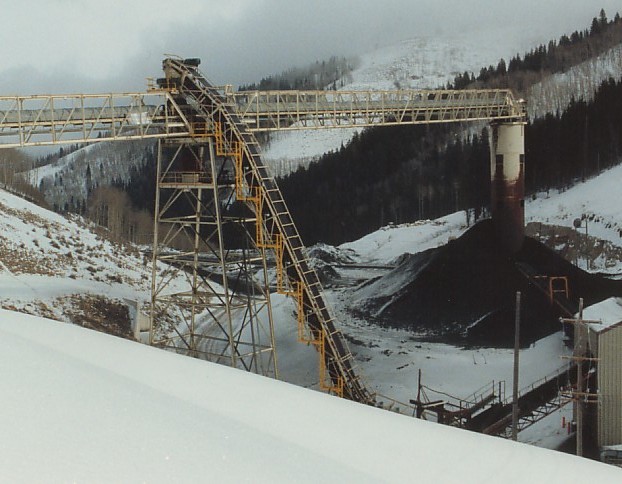
The wide use of longwall systems in the 1980s required upgrades and replacement of existing conveyor lines to keep up with production. In deep coal mines, this resulted in choking at the main haulage shaft where existing skip hoists couldn’t meet the increased production requirements. This created great opportunities for high angle conveyors in the 1990s.
Another case of raw coal haulage from an underground coal mine elevated raw coal from the mine mouth of a coal mine in Valley Camp, UT USA. It elevated raw coal at 1,089 t/h from the slope conveyor to another upper conveyor that takes coal to stack out through a stacking tube.
CRUSHING AND SCREENING
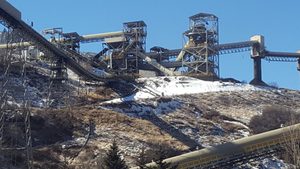 Two Sandwich Belt high angle conveyors, part of a coal crushing and screening system received primary crushed coal to a 203 mm size on a 1,524 mm wide belt from underground and elevated it to a screening tower. All 51 mm minus material passed through the screens and was conveyed to a load-out silo while the 51 mm to 203 mm size passed over the screens and was loaded onto the other high angle conveyor on a 1,219 mm wide belt, elevating it to a rotary breaker. At the breaker, rock was separated from the coal and discarded. The remaining coal was sent to silo for train loading.
PREP PLANT FEED
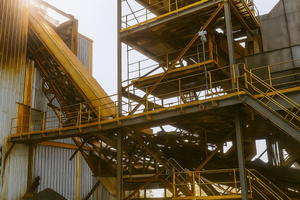
Used in another critical location of the mine to prep plant route, a Sandwich Belt unit elevated run-of-mine coal from a rock removal rotary breaker at 1,089 t/h, providing a continuous feed to the prep plant.
BETH ENERGY EAGLE NEST MINE
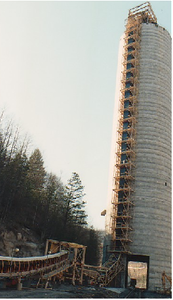 Beth Energy’s Eagle Nest mine in West Virginia revamped its clean coal handling system. They had to solve the problem that its clean coal loading system was choking off the ability of its plant to realize full design capacity. The implementation of the Sandwich Belt high angle conveyor improved the overall coal handling capabilities, loading coal directly from the plant into railcars.
The plant had been averaging a 75-car CSX unit train daily. To meet the plant design capacity, they needed to be able to load a 90-car unit train daily. To do this, Beth Energy designed a new 10,000-ton loadout silo to operate at 4,000 tph, loading the 90 railcars in 2 hours and 15 minutes. In designing the new loadout, they looked at all the high angle conveyors on the market. They were concerned about the limitations to the angle they could accommodate. Finally, they decided a vertical conveyor would save them on space and maintenance.
Ultimately, they decided on the Sandwich Belt high angle conveyor because of the ease of construction, construction costs, ease of operation and maintenance and readily available, off-the-shelf components, making it the first vertical Sandwich Belt conveyor for coal.
The total length of the Sandwich conveyor was just over 90m and it delivered 127mm minus size coal at 726 t/h at a belt speed of 1372 mm (54 inches) belts is 2.79 m/s. Each belt used a 112-kW drive.
COAL HANDLING EXPANDS TO EUROPE
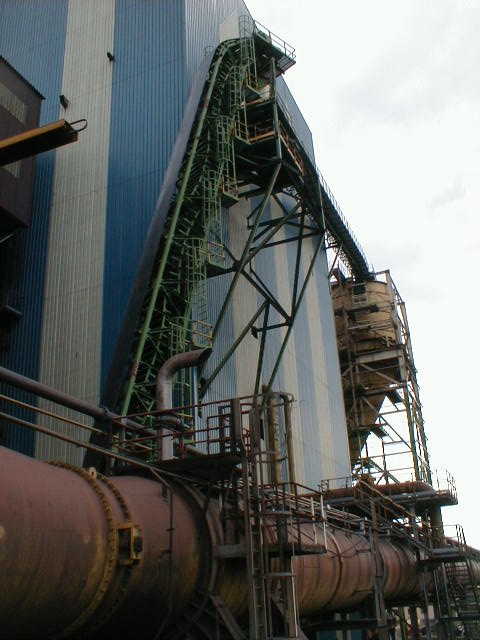
In August 2000, PHB Weserhutte (PWH) S.A., of Gijon, Asturias Spain went online in search of the best equipment to elevate raw coal to the blast furnace coal grinding plant of a major steel producer in Northern Spain. PWH offered a system expansion including increased coal throughput to new and existing blast furnaces.
An existing vertical pocket belt system proved to be problematic as it did not completely discharge the moist coal. This resulted in carryback and created a clean-up problem.
The original analysis was that the first conveyor would replace the troubled pocket belt system in the existing pulverizing plant. A second Sandwich Belt conveyor would elevate to the new pulverizing plant. After some analysis, PWH and DSI found they could serve both pulverizing plants with one DSI Sandwich Belt conveyor system instead of two. The conveying path to the new plant would pass the existing plant, thus a single Sandwich Belt conveyor, with a bifurcated discharge chute and flop gate could direct the raw coal flow alternately to the new pulverizing plant.
SANDWICH CONVEYOR, THE OPTIMAL PATH FROM DOWN RIVER CBU
A new system layout required a new conveying path from a downriver CBU to a new down-river transfer complex at a major transfer terminal on the Mississippi River delta. The direct path to discharge over the downriver yard belts subtends an incline angle that far exceeds the capability of any conventional open-troughed belt conveyor. The reflexive solution was to use two conventional conveyor flights in a switch-back arrangement. The 9° maximum incline limitation and the location over water made this a costly proposition. The large (environmental) footprint was also a negative.
Because of the long relationship with Dos Santos International, terminal personnel knew there was a better solution: a DSI Sandwich belt high angle conveyor. At 3629 t/h (4000 STPH) of coal, this would be the highest volumetric rate to date for a Dos Santos Sandwich Belt High Angle Conveyor. The terminal management, in their due diligence, sent key professionals to visit the operation of Dos Santos Sandwich units handling coal at high volumetric rates. These visits, and discussions with operating and maintenance personnel, confirmed that the DSI Sandwich conveyor was the best solution.
The DSI Sandwich belt system was part of the coal flow path from the original down-river CBU to the top of the new down-river transfer tower. The bucket ladder-type CBU unloads the coal from the barges and discharges it onto the gathering “A” conveyor, which discharges to the connecting “B” conveyor. The DSI Sandwich conveyor would receive the coal load from the B-conveyor discharge and elevate it continuously up to the transfer tower, for distribution to the alternate terminal destinations. The CBU would travel up and down the support tower as required; to clear the empty barge at the highest river level and to dig into the fully loaded barge at the lowest river level. Thus, the tail of the connecting B-conveyor follows the CBU travel while the head end pivots to the resulting incline angle. The material that would discharge onto the DSI Sandwich conveyor would vary accordingly. Special features of the system include a galvanized steel structure, corrugated covers and wind guard, and a full-length stainless-steel drip pan to a strategic discharge point at the foot of the inclined structure. Naturally, at a 52° incline, the drip pan is self-cleaning. Additionally, the bottom belt tail end is extended back, behind the loading area, to facilitate belt splicing.
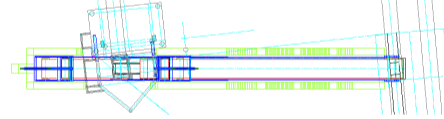
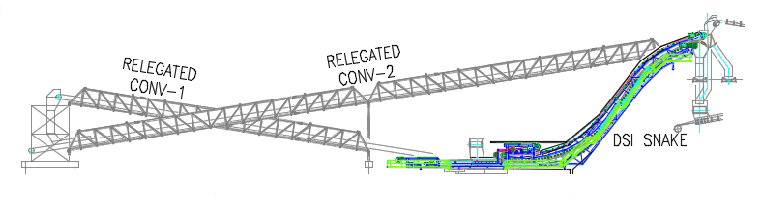
The DSI Sandwich Belt high angle conveyor is a substantial improvement over the switch-back conveyor arrangement originally conceived. It eliminates a transfer, along with the substantial additional tower and foundations that would be required to support the switch-back transfer. Its shorter path and material containment further the limits the environmental impact of the material handling system. These, among other benefits of the DSI Sandwich Belt conveyor, made this unit an ideal solution for this application.
Dos Santos Sandwich Belt systems have been proven economical and reliable in coal handling over the past four decades. While several were mentioned here in detail, there are others as shown in the chart below.
| Location | Material Rate (mt/h) | Angle (°) | Elevating Height (m) | Length (m) | Belt width (mm) | Belt speed (m/s) | Drives (kw) Top/Bottom |
| WY, USA | 2450 | 60 | 32.9 | 56.7 | 1524 | 5.3 | 149/224 |
| WY, USA | 2903 | 35 | 29 | 61.9 | 1829 | 4.6 | 149/224 |
| WV, USA | 1089 | 49 | 21.9 | 40.2 | 1372 | 2.8 | 56/56 |
| WV, USA | 726 | 90 | 76.2 | 90.2 | 1372 | 2.8 | 112/112 |
| UT, USA | 1089 | 65 | 30.7 | 44.2 | 1372 | 3.6 | 93.2/93.2 |
| VA, USA | 454 | 41 | 174.8 | 454.2 | 914 | 2.3 | 186/186 |
| WV, USA | 544 | 90 | 16.1 | 69.4 | 1372 | 2.8 | 37.5/37.5 |
| FL, USA | 1814 | 48 | 14.2 | 57 | 1829 | 3.6 | 75/112 |
| CO, USA | 1361 | 51 | 22.6 | 44.2 | 1524 | 3.6 | 75/93.2 |
| CO, USA | 272 | 35 | 15.0 | 37.5 | 1219 | 1.3 | 11.2/14.9 |
| WY, USA | 1950 | 57 | 59.4 | 90.8 | 1829 | 3.7 | 186/298 |
| IL, USA | 1361 | 90 | 102 | 113 | 1524 | 4.6 | 298/298 |
| South Africa | 400 | 90 | 13.3 | 39.3 | 1200 | 2.2 | 30/30 |
| South Africa | 400 | 90 | 13.3 | 40.3 | 1200 | 2.2 | 30/30 |
| South Africa | 400 | 90 | 13.3 | 43.4 | 1200 | 2.2 | 30/30 |
| South Africa | 600 | 90 | 13.3 | 40.3 | 1350 | 2.6 | 45/45 |
| South Africa | 600 | 90 | 13.3 | 40.3 | 1350 | 2.6 | 45 |
| PA, USA | 260 | 55 | 28.3 | 75 | 762 | 2.3 | 22.4/22.4 |
| PA, USA | 260 | 60 | 48.5 | 75 | 762 | 2.3 | 30/37.3 |
| AK, USA | 136 | 90 | 13.8 | 41.4 | 1067 | 1.5 | 11.2/14.9 |
| Zimbabwe | 7 | 90 | 16 | 68.3 | 500 | .7 | 0/6 |
| Canada | 200 | 90 | 17.4 | 34.3 | 914 | 2.8 | 22.4/22.4 |
| WV, USA | 317 | 33 | 15.2 | 31.1 | 914 | 2.3 | 0/37.3 |
| IL, USA | 635 | 45 | 38.1 | 69 | 1219 | 3.0 | 75/75 |
| Indonesia | 200 | 60 | 19 | 46 | 762 | 2.3 | 22.4/22.4 |
| Indonesia | 200 | 60 | 19 | 46 | 762 | 2.3 | 22.4/22.4 |
| CO, USA | 136 | 90 | 10.8 | 36.6 | 914 | 2.0 | 0/14.9 |
| South Africa | 120 | 90 | 34.8 | 106 | 750 | 2.3 | 30/30 |
| UK | 120 | 90 | 28.6 | 39.2 | 1000 | 3.0 | 30/30 |
| CO, USA | 272 | 65 | 30.2 | 33.7 | 1067 | 1.9 | 37.3/37.3 |
| Spain | 250 | 75 | 35 | 45 | 1200 | 2.3 | 30/30 |
| LA, USA | 3629 | 52 | 18.5 | 46 | 2438 | 4.5 | 224/224 |
Contact DSE to discuss high-angle conveyor engineering for your mine or industrial facility.
