
Upgrade of High Angle Conveyor
Industry: Cement | Service: Engineering
CHALLENGE:
- Inconsistency in the material at the inlet and outlet of the sandwiched belts reveals movement of the material enroute.
- Poor execution of the inflection zone.
- Non-compliant replacement belts.
- Incorrect idlers troughing angle, not correctly troughed and shimmed and pressing rolls were worn and needed replacement.
Develop a Proper Inflection Zone
To achieve proper performance of this HAC, DSI had to develop a proper inflection zone. This introduced a reverse curve just beyond the lower transition curve as shown below.
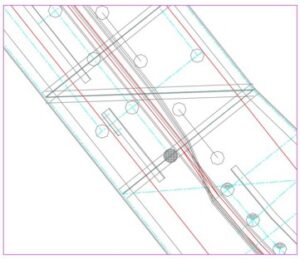
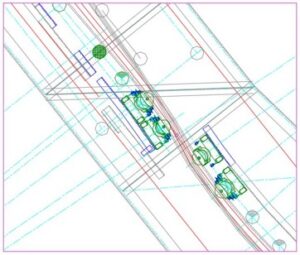
The original lower curve must be extended beyond tangency with the straight HAC conveying angle. An additional reverse curve is introduced to bring the belt line back to the straight incline. Because this was a retrofit the belt line after the second short curve will be elevated about 4 inches above the original straight incline. Thus, this new belt line will be gradually worked back to the original straight inclined belt line, about halfway up the straight incline. New, additional steel support stringer and brackets will be required to achieve this.
Four FEI (fully equalized idlers) will be installed, two to either side of the inflection zone. These represent the latest in high angle conveying technology and were developed specifically for maintaining hugging pressure through the inflection zone, preventing any material slippage and spreading.
REPLACE INCORRECT OR WORN COMPONENTS
The replacement belts were incorrect and don’t conform with the radius of curvature constraints as specified by CEMA and DSI. The troughed belts, along the lower transition curve thus have a relaxed middle that does not hug the material load. The material thus moves within the sandwich as it is elevated along the high incline path. DSI supplied the necessary information to order complaint belting that is measured using the ISO 9856 test.
Idlers along the straight (pressed) incline will be returned to the original 35-degree troughing, with all steel rolls.
Frozen pressing rolls, or those worn into a conical or football shape will be replaced.
Along the lower curve, replace frozen bottom belt return idler. Along the carrying belt line, replace frozen near side steel roll and replace the several damaged rubber disc center rolls.
At the fully equalized pressing modules, many roll brackets are upside down and must be turned right side up, with the roll nut slot pointing down.
The final 20-degree troughing idler before the bottom belt discharge pulley must be shimmed to maintain a horizontal neutral axis belt line.
Narrowing of the skirts (tapering the width between the skirts) along the length must be avoided in order to minimize wear and tear. Skirt width must be reduced to half belt width per original design.
Adjust deflection plates introduced to the loading zone, per the original design.
Improve scraper system. Bottom belt scrapers after being cleaned required more blade pressure against belt/pulley. Additional scrapers could be installed along the bottom belt return. Top belt scrapers needed modification for better contact. Change the rubber disc backing roll to steel. Secondary scraper needed to be repositioned 45 degrees to keep materials building up behind the blade.
SOLUTION:
This Continental HAC was commissioned in 1998, less than a year after Joe Dos Santos, inventor of the Continental HAC departed the company. His expertise on the system allowed for the challenges to be corrected.
Contact DSE to discuss high-angle conveyor engineering for your mine or industrial facility.
