
Wyodak Mine
Industry: Mining | Service: Engineering
New Upper Support at HAC
On the night of the 28th of June 2013, a large storm blew through the town of Gillette, Wyoming. This storm, with reported wind gusts above 120 mph, damaged the upper support of the High Angle Conveyor, R-1, at the Wyodak Mine.
The high angle conveyor at Wyodak delivers coal, at a 57-degree incline angle, up to the center of a 5000-ton silo where it can discharge directly to that silo or, by actuation of a flop gate, can divert the coal flow to an adjacent 5000-ton silo. The structural system has only two major support points; a lower fixed hinge support at grade and an upper hinge-hinge frame, on the silo wall. The upper hinge-hinge frame allows expansion while offering a vertical support reaction. The truss support system consists of two major truss sections, the first from grade to the silo wall, and a second which cantilevers from the silo wall to over the middle of the silo. There is no support at the silo center. Rather, a steel bent mast with cable stays carries the cantilevered truss and all of its equipment in suspension from the silo wall. The back stays transfer the cantilever moment, in tension, back to the main truss that runs from grade to the silo wall. Figure 1 depicts the HAC profile, the structural system and summarizes the operating parameters.
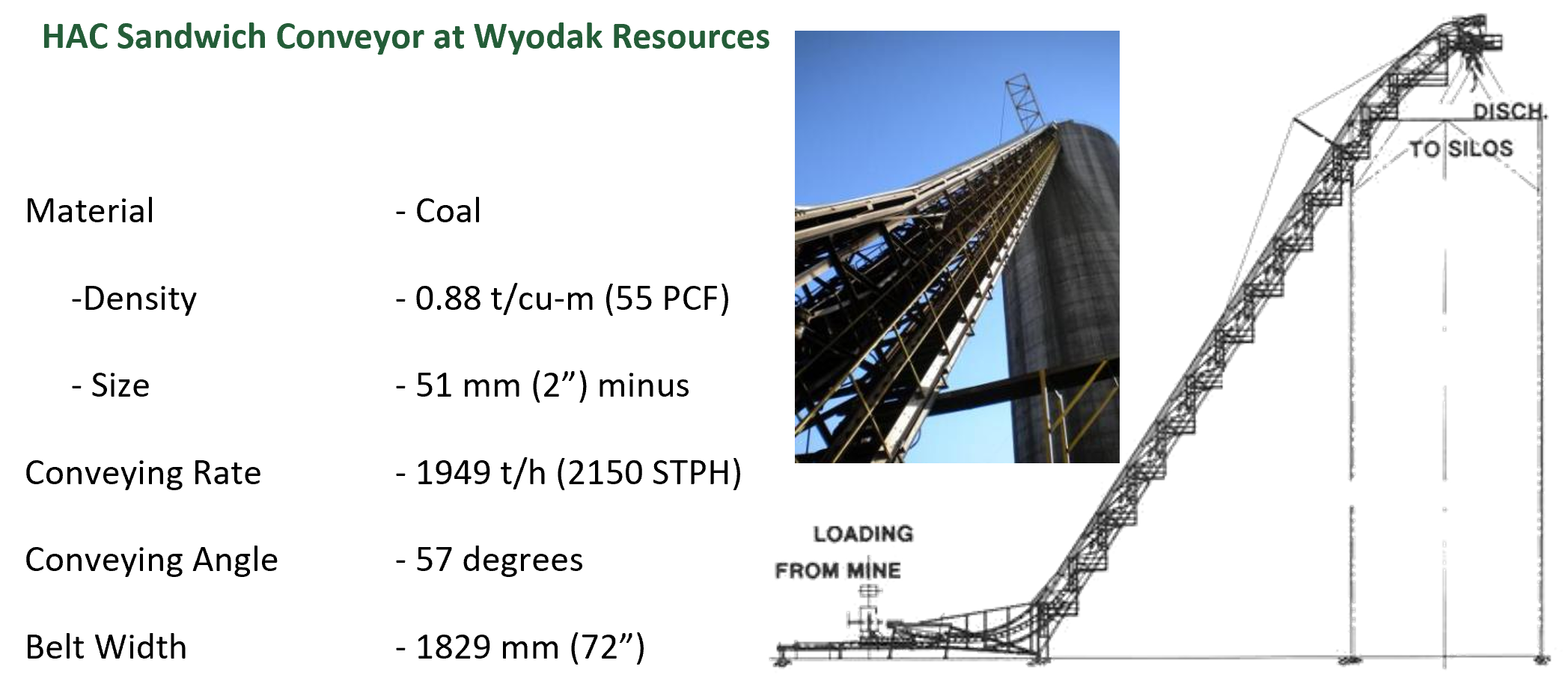
The R-1 conveyor is critical to mine operations. It feeds the two silos, which subsequently feed Wygen 1 and 2, two of the four power plants on site, and it facilitates the mine’s truck loading operations.
On the night of the incident, Black Hills Power personnel contacted Dos Santos for their expert advice. This was a natural reaction as Black Hills Power were well aware of the expertise in the Sandwich Belt high angle conveyor technology and more broadly in the engineering of mechanical and structural systems. Indeed, the original design of the R-1 conveyor was conducted under the direction of J. A. Dos Santos, inventor of the HAC and founder of the company. Against this background, Black Hills Power contracted Dos Santos to inspect the failure and to develop the repairs that would return the HAC to productive operation.
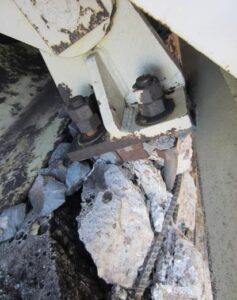
Upon Dos Santos’ arrival at the site, the conveyor was thoroughly inspected. With the upper wall support collapsed, the lower truss came to rest (leaning) against the silo wall, and the cantilevered head end came to rest on the steel framing that supported the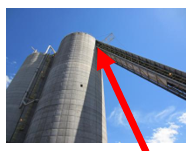 receiving chute work and transfer conveyor. The overhead cable stays that previously cantilevered the upper structure were now slack and carried no load. Inspection revealed very little physical damage to the High Angle Conveyor structure. The failure was contained within the area surrounding the upper hinge-hinge support frame. More specifically, the failure was at the top of the silo wall, at the concrete directly under the lower hinge pedestals. Dos Santos concluded that the wind from the storm pushed the conveyor toward the silo. This forced the upper hinges (of the hinge-hinge frame) towards the silo center forcing some rotation about the lower hinges. The forward rotation meant that the upper reaction load now applied a horizontal outward load in addition to the vertical load for which the system was designed. The combination subsequently blew out the lower concrete support. Figure 2 shows the location and the extent of the damage.
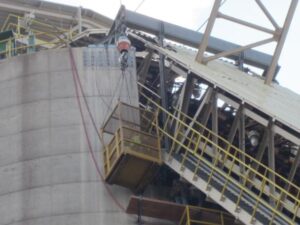
As a solution, Dos Santos decided to build a new hinge-hinge type support. However, this time larger, doubly hinged bars would hang from a cross beam that would span the width of the conveyor truss and access, above the conveyor, on the silo wall. Figure 3 shows the new overhead crossbeam and hangers. This solution allowed easy access to the new support system and facilitated securing the load temporarily from the new upper crossbeam, while working safely at the former structure, removing the old hinge-hinge frame and welding two stages of temporary cross beams and a permanent cross beam under the truss structure. The first temporary crossbeam, a thick rectangular bar across, was to lift the HAC upper support point, only slightly, enough to relieve the load on the old support. This was to allow its safe removal and to allow the installation of the lower lifting beam and the permanent crossbeam that would connect with the hanger bars at the same location as previously. Because the new hangers are longer, the design more easily accommodates the longitudinal displacement of the conveyor.
In order to place the conveyor back in its original location, the contractor utilized a “jacking beam” atop the permanent upper supporting beam, with chain falls attached to a temporary lifting beam, installed full length underneath the conveyor structure, adjacent to the lower permanent support beam. With two 55-ton jacks, the conveyor was slowly lifted back into place. Once lifted, the new hanger bars and pins were installed. The fixed length of the bars confirmed that the conveyor had been placed in its final design position. Finally, a lateral hinge-hinge bar was installed, connecting the lower hanger beam to the silo wall. This lateral hinge-hinge support is designed to resist the side loads on the conveyor system while allowing free expansion of the structure.
Much to the credit of the contractor, Black Hills personnel and Dos Santos, R-1 was up and running, conveying coal within the scheduled 8 weeks.
Contact DSE to discuss high-angle conveyor engineering for your mine or industrial facility.
